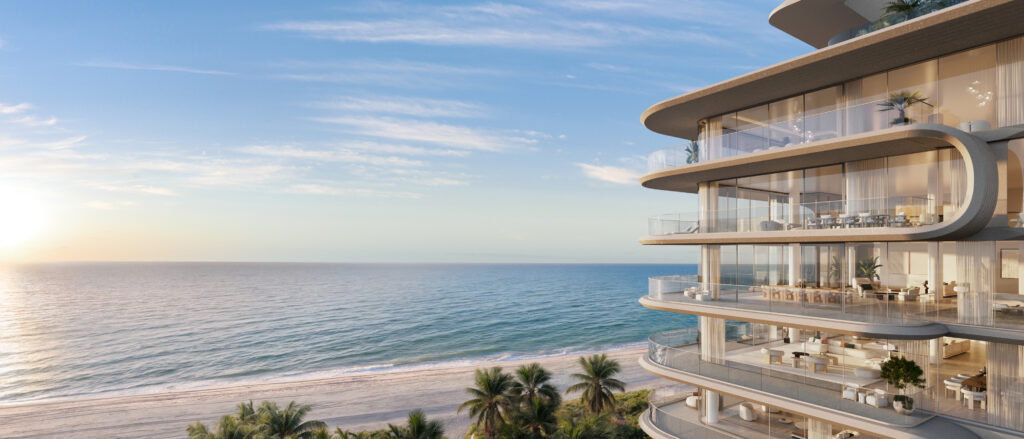
When you step into The Delmore‘s sales gallery in Miami Beach, it’s immediately clear that this property is not like any other. You pass through a gate, verify your identity with security, and enter a cool, darkened corridor where a 75-foot digital lagoon shimmers overhead. A swimmer languidly glides across the ceiling. You are no longer in Surfside; you are inside a film.
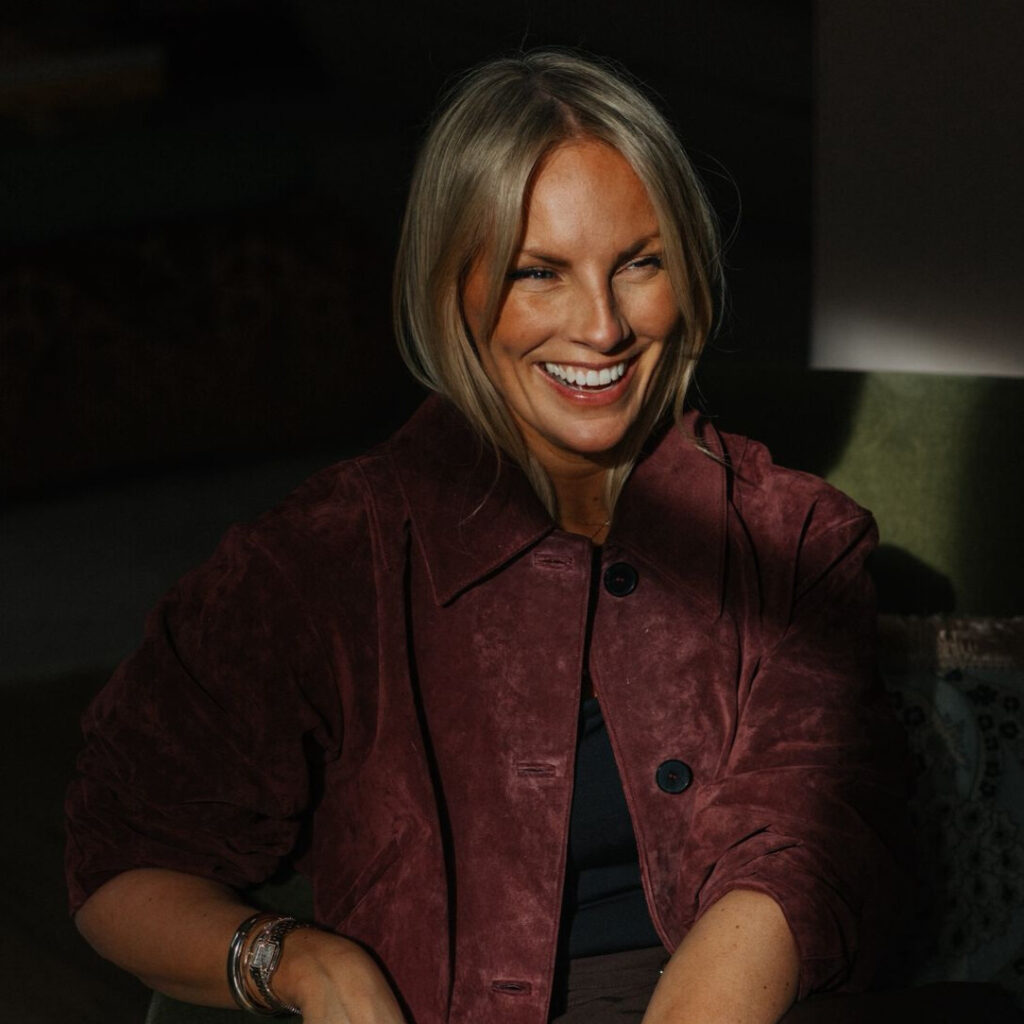
A film, it turns out, set designed by Katie Earland the team at HBA.`
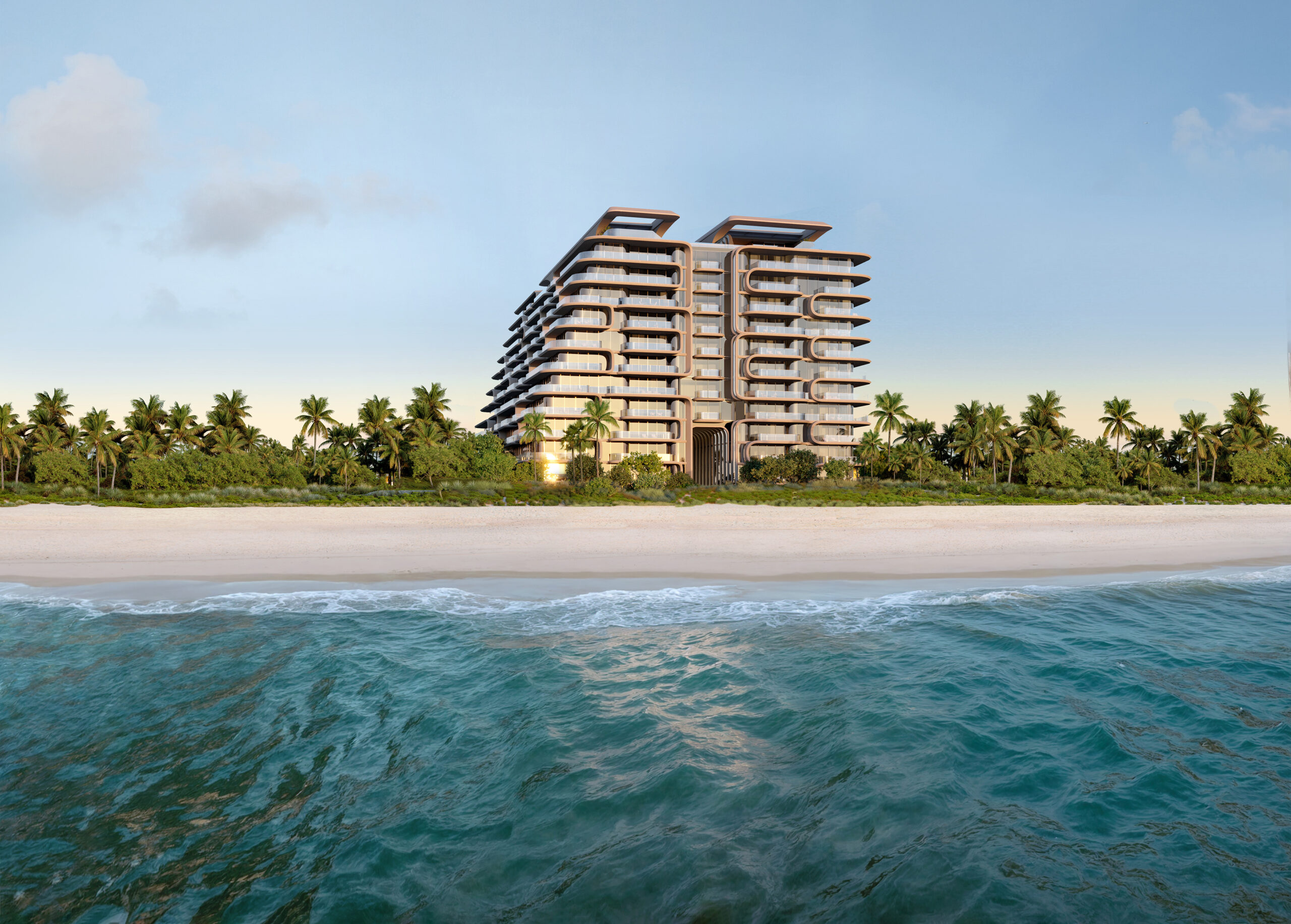
As Creative Director at HBA Residential, Earl has spent over 15 years shaping some of London’s most exclusive addresses—The Boltons in Chelsea, Cornwall Terrace at Regent’s Park, and Eaton Square in Knightsbridge. But The Delmore, Zaha Hadid Architects‘ first residential masterwork in Florida, presented something altogether different: the task of translating the vision of a legend into livable space.
I sat down with Earl to discuss how she approached the project, the nuances of designing for the ultra-wealthy, and why a team of women might just be the perfect stewards for a $150 million penthouse.
Branded Living: When I visited The Delmore sales gallery in January, I was struck by how seamlessly the interiors blend with the exteriors. Walk me through your creative process for approaching this project. Did you start with research in Miami?
Katie Earl: We tend to approach every project the same way, by first receiving a brief from the client. In this case, they were heavily invested—they really wanted to be part of the journey. But before any of that, our senior leadership team actually visited the site. We went down to the beach, we understood the culture of the location, and we took a strong brief even from the realtors about who is buying here and what language we’re speaking.
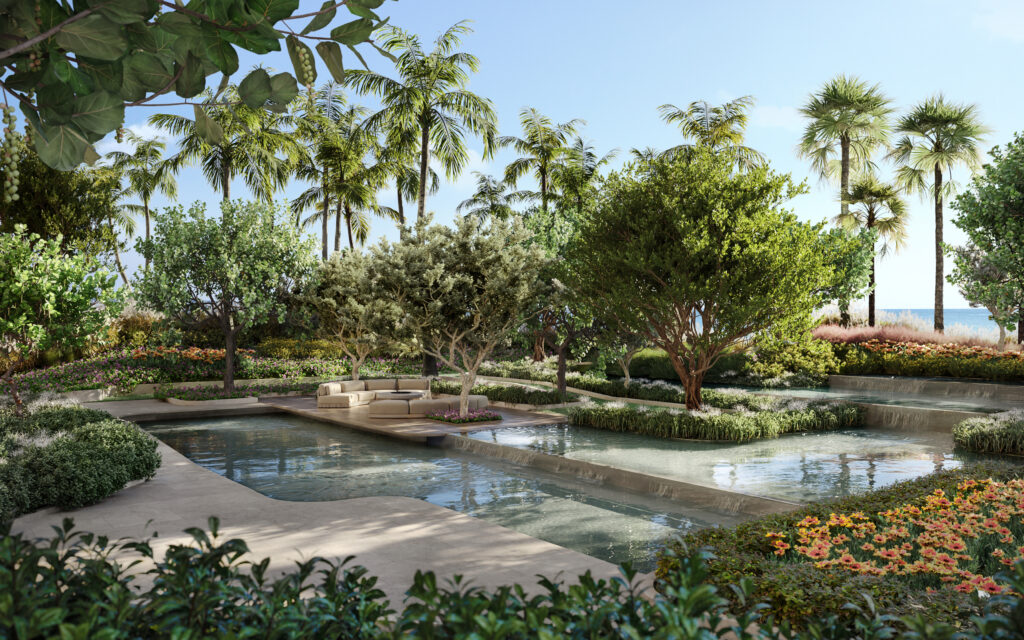
And then something lovely happened. The team picked up these gorgeous little shells from the shore. That became this nice, kind of inheriting the landscape and translating it as a design influence into the interior. That soft, sculptural movement of the dunes became something that mimics the travertine we used. We chose a vein-cut travertine so that the vein moved in a similar way to the dunes moving. We weren’t choosing bold, striking marbles. We were choosing things that mimic the flow of the location.
BL: Working within a Zaha Hadid Architects structure is a distinct responsibility. How does your design process differ when the architectural language is already so powerful?
KE: For us, it was all about inheriting and being accommodating and respectful to the existing architecture. The design has to be harmonious. There can’t be challenge between the interior designer and the architect. It has to be hand-in-glove.
We’re inheriting a design, a landscape, a location, a culture. Zaha’s architecture has this fluid form and sculptural softness, but there’s also robustness to it. Our job is to take that bigger concept and translate it into a domestic environment. Those detail sets become things like the sculptural form of vanity basins or kitchen islands, or softening curves on things that are gently respectful to the architectural moves happening externally. They’re big moves, and we’re making them into smaller scale but repetitive in a way that means you feel connected to the outside, even when you’re inside.
BL: It struck me, walking through, that The Delmore has a kind of James Bond quality to it—premium, private, secure, utterly distinct. Was that intentional?
KE: That’s such a good observation, and it links to how we’ve been so successful in working in the development arena. We’re designing for that kind of 1%—the James Bond moment. These clients are so tailored, so exacting in what they want and expect. How their life moves, how they’re looked after, everything from the safes to the vanity bridges to the experience as soon as you get out of their car.
We design for those people, for that end user. When we were creating the scheme, we kept that client in our minds constantly. One key reference for us was bringing in the idea of a European-style approach to wellness and lifestyle. In the spa, for example, we used Moroccan plaster finishes in some of the plunge pools, and this gorgeous mother-of-pearl shell mosaic in the treatment spaces—another nod to those shells we’d collected on the beach. It’s a subtly romantic connection that just came naturally from the material concept.
BL: This project features remarkable female leadership—you, your team, a female-led sales team. Does this dynamic bring a different perspective?
KE: This was possibly my favorite question. I think women design with a feeling in mind. We ask: How does the space feel? What’s the emotional attachment? What’s the experience you will have when you’re in it? That’s something embodied—it’s not necessarily physical yet, and it becomes physical through palette, space, and flow.
But in essence, it’s designing based on how you want somebody to feel. I think that’s such a feminine, energetic thing. It’s a feeling rather than a physical being. The way that becomes tangible is through softness. As soon as you’re through the front door into the lobby spaces, there’s a calmness. In the spas, there’s tranquility. In the apartments themselves, it’s an elevated feeling of expansive views.
We did a big space planning appraisal, and we were considering—because Zaha is incredible at designing buildings from the outside, how a building looks and moves—we were considering always from the inside looking out. How do you move a purchaser through their own apartment in a way that feels effortless? What sightlines might they have? We had nice opportunities at the end of corridors with artwork niches prepared, acknowledging that they may come with a collection, highlighting locations for things that are sentimental. That helps spaces become home.
BL: What was the most rewarding moment of creative collaboration on The Delmore?
KE: I think the spa spaces were super successful. That idea of European wellness, and then finding those material connections back to Miami—the shells, the dunes, the quality of light. But more than any single moment, it’s about the relationship. The developer here trusted us because the team had worked with him before. He felt safe with us. That’s the thing about this studio—we’ve never worked on just one project for any client. We always have return relationships. That’s built on trust and enjoying the process together.
BL: The sales gallery is the first physical touchpoint, the moment a buyer moves from renderings to reality. How do you translate The Delmore's ambition into that space?
KE: It had to feel like an extension of the end result. Tactility, texture, materiality—everything in that space is being used already. You can touch it, feel it. It’s so compelling because you’re not in a space that misrepresents itself. You’re in a narrative tool that, just by existing within it, gives you the feeling of the home you’re purchasing.
There’s an emotional connection to the building already, because you’ve experienced it. That sensory environment helps buyers understand—and these are knowledgeable buyers, with multiple homes, who’ve done this many times. It’s hard to imagine 3D space from a brochure. To have that tailored asset as a sales tool is invaluable.
BL: What happens after a buyer moves in?
KE: As a service, we deliver right up until they could turn up with a toothbrush. I’ve installed Dyson hairdryers in guest bathrooms. I take briefs from property management about what clean products they want to use. I have residents from previous projects who are now really good friends, because you build this wonderful relationship. They’ll text me: “I bought this piece. Where do you think it should go?” And I know their house inside out because I designed it.
That’s the beauty of it. At the end of the day, we’re designing homes for wonderful people. And when you’re on that journey with them, it doesn’t end. They’ll own multiple assets, and they’ll come back and say, “I’ve got this house somewhere else. Could you help?” That trust, that relationship—that’s what makes it all worthwhile.
The Delmore, designed by Zaha Hadid Architects with interiors by HBA Residential, is under development in Surfside’s “Billionaire’s Triangle.” A penthouse here is poised to ask $150 million. Completion is anticipated in 2029.