From Kempinski to Fendi Casa, European brands, designers, and buyers are converging on South Florida simultaneously. Inside the shift reshaping the region’s most ambitious residences.

From Kempinski to Fendi Casa, European brands, designers, and buyers are converging on South Florida simultaneously. Inside the shift reshaping the region’s most ambitious residences.
|
Getting your Trinity Audio player ready...
|
Something is shifting in South Florida’s luxury residential market. We sensed it on our last media tour when the theme of Italy kept coming up over and over in our sales presentations.
European capital has been arriving in the region for years. What is different now is that European design, European hospitality brands, and European buyers are arriving together, at scale, and with a level of intentionality that is reshaping not just what gets built, but how it gets built and for whom. Foreign buyers committed $4.4 billion to South Florida real estate in 2025, a 42% increase over the prior year. European buyers now account for 18% of international purchases across Florida, tied with Canada for second behind Latin America. In Miami specifically, approximately 15% of all home purchases were made by foreign buyers in 2025, against a national average of 2%. According to a first-of-its-kind survey of new development sales, foreign buyers purchased 49% of new construction condominium units in South Florida over an 18-month period ending June 2025.
The product being built in response is markedly different from what South Florida has historically seen.
If there is a single cultural influence running most visibly through this transformation, it is Italian. Not Italian in the branding sense, but in the deeper sense of design philosophy: proportion, restraint, material integrity, the idea that a residence should be planned for how people actually live rather than how it will photograph.
At The Residences at 1428 Brickell, developer Ytech brought in Milan-based ACPV ARCHITECTS, the firm led by Antonio Citterio, to design what has become one of the most discussed residential projects in the city. Andrew Kraynak, Chief Sales and Marketing Officer at Ytech, describes the approach precisely: “European buyers tend to look past spectacle very quickly. They focus on proportion, privacy, material integrity, and whether a residence will age well. The feedback we hear from European buyers is often about the discipline of the design: the scale of the rooms, the relationship between social and private spaces, the depth of the terraces, the quality of the materials, and the sense that the residence was planned for daily living.”
The material specification at 1428 Brickell reads like a procurement list from northern Italy: Arclinea kitchens, Rimadesio glass partitions, Salvatori stone. Custom Italian cabinetry. Sculptural carved-stone bathtubs sourced from Italian quarries. “The European influence in Miami is not only about brands,” Kraynak continues. “It is about a higher sensitivity to proportion, craftsmanship, restraint, and permanence.”
That sensibility is extending well beyond a single building. The One Atelier, the Milan-based consultancy that has now completed four branded residential projects in Miami alone — Armani Casa Residences Pompano Beach, Elle Residences, 888 Brickell by Dolce & Gabbana, and Avenia by Fendi Casa — has watched the convergence unfold in real time. “International demand has created a growing preference for a more European way of living in Miami, where design and lifestyle are part of the same lived experience,” says Michele Galli, CEO of The One Atelier. “Miami has become a natural hub for European brands to express themselves in real estate. It attracts a buyer who is used to moving between cities and who understands design excellence and brand value.”
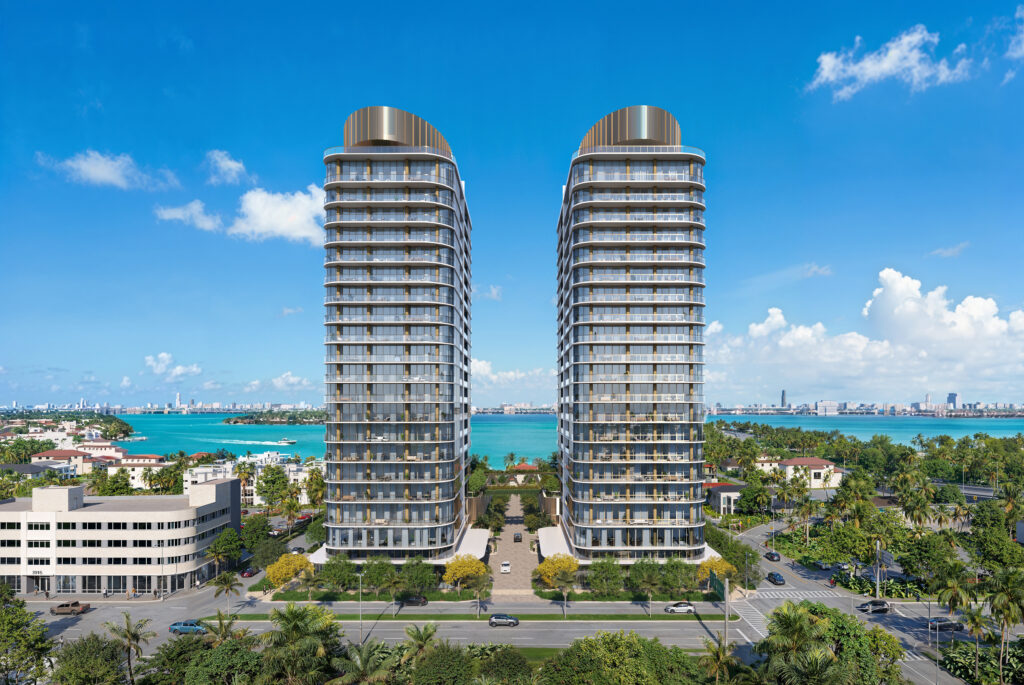
The Italian design influence has been joined by a broader wave of European hospitality operators choosing South Florida as their U.S. entry point.
Kempinski, Europe’s oldest luxury hotel group, selected Miami’s Design District for its first standalone residential project in the United States. The 132-unit Kempinski Residences Miami Design District, developed by DaGrosa Capital Development Partners, arrives in a neighborhood that has spent two decades building one of the most concentrated luxury retail environments in the country — Chanel, Hermès, Bottega Veneta, Gucci — and is now adding nearly 1,000 residential units to its pipeline. Joe DaGrosa, Founder and Chairman of DaGrosa Capital Development Partners, describes the buyer being drawn to the project: “They’re not just purchasing a second home. They’re comparing Miami to other global cities where they already own property and spend time. The focus is less on excess and more on livability — larger, family-oriented layouts, meaningful outdoor space, and a true residential feel, reflecting that many of these buyers are spending extended time here.”
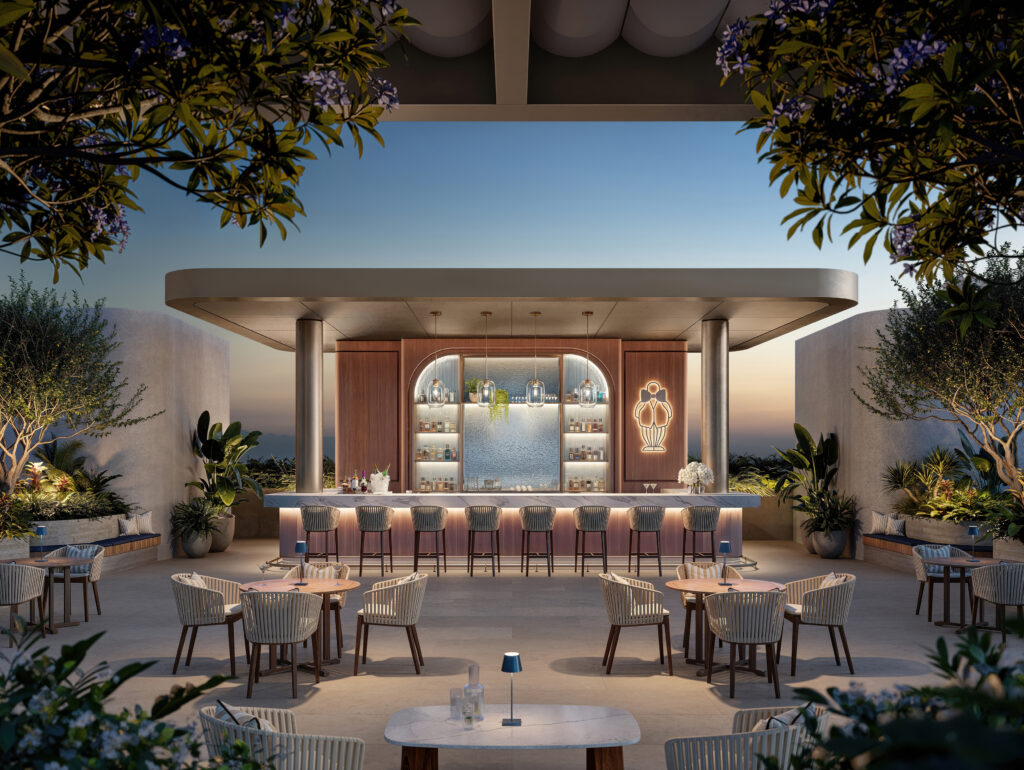
In Boca Raton, Mr. C — the residential brand rooted in four generations of Cipriani family hospitality — has announced the city’s first new branded residential project in more than a decade. The 12-story, 133-unit tower at 41 SE 4th Street, designed by Arquitectonica with interiors by London-based 1508 London, brings Italian dining heritage through its ground-floor Bellini Restaurant alongside a wellness program anchored by a dedicated spa level. Inigo Ardid, Co-President of Key International, frames the project’s relationship to the broader trend directly: “Miami offers what many established global cities no longer can: a combination of international demand, waterfront access, and a still-evolving urban fabric that allows capital and design influence to shape the market rather than simply enter it. At Mr. C Residences Boca Raton, that same dynamic extends to Boca, where European design and hospitality sensibilities are reflected in a coastal residential setting.”

The Ritz-Carlton Residences, Fort Lauderdale Beach is delivering a boutique collection of 83 residences shaped explicitly around the expectations of the international buyer. Diana Ulis, CEO and Founder of Admire Capital, describes what that buyer is bringing to the conversation: “Miami and South Florida more broadly have become a natural meeting point for international capital, design, and hospitality brands, particularly from Europe, where we’re seeing a growing alignment in expectations around quality, service, and lifestyle. For European buyers in particular, the appeal lies in the combination of waterfront living, year-round climate, and a level of residential service that mirrors the world’s best hotels, but within a more contemporary, design-forward context.”
The question worth asking is why South Florida, and why now, rather than a decade ago.
The answer that comes back consistently from developers and advisors is not one thing but a convergence of several. Miami is no longer a regional American city with a beach. The share of homes valued above one million dollars in Miami-Dade has risen from 8% in 2019 to 28% in the first quarter of 2026, and to a foreign investor comparing Miami to London, Singapore, or Zurich, those figures register as confirmation that the market has arrived at a different tier entirely. (Source: Branded Living).
Kraynak puts the buyer’s calculus plainly: “Miami used to be understood primarily through lifestyle. Today, the strongest projects are proving that lifestyle and serious residential quality can exist in the same place. The city now has better architecture, stronger cultural institutions, better dining, deeper capital, and a more sophisticated international buyer base.” The tax structure remains a meaningful part of the equation — no state income tax, no estate tax — but developers are consistent in noting that for this buyer, it is a confirmation rather than the primary motivation. They are not moving to Miami for the tax savings. They are moving for the quality of life, and the tax environment removes the last reason not to.
DaGrosa identifies something subtler: Miami’s relative earliness. “Miami has fully emerged as a global city, but it is still earlier in its evolution compared to more mature markets like London or New York, which creates a compelling opportunity for buyers. You have newer inventory, more space, and in many cases better relative value. That combination is difficult to replicate elsewhere.”
Galli frames the moment in terms of what comes next: “The market is open to new concepts and there is a willingness to invest in projects. What will define the next stage is the strength of the concept and how well each project reflects the brand ethos behind it.”
That is, ultimately, what the Europeanization of South Florida is producing: a market where the brand on the building is no longer a shortcut to premium pricing, but a commitment to a specific and legible way of living. The buyers arriving from London, Milan, and Zurich already know the difference. The developments competing for their attention are being built accordingly.
Branded Living Pro tracks active brands and developers, pricing, square footage, neighborhood trends, and the latest news — all powered by brandedresidences.ai. Explore the Miami market overview.