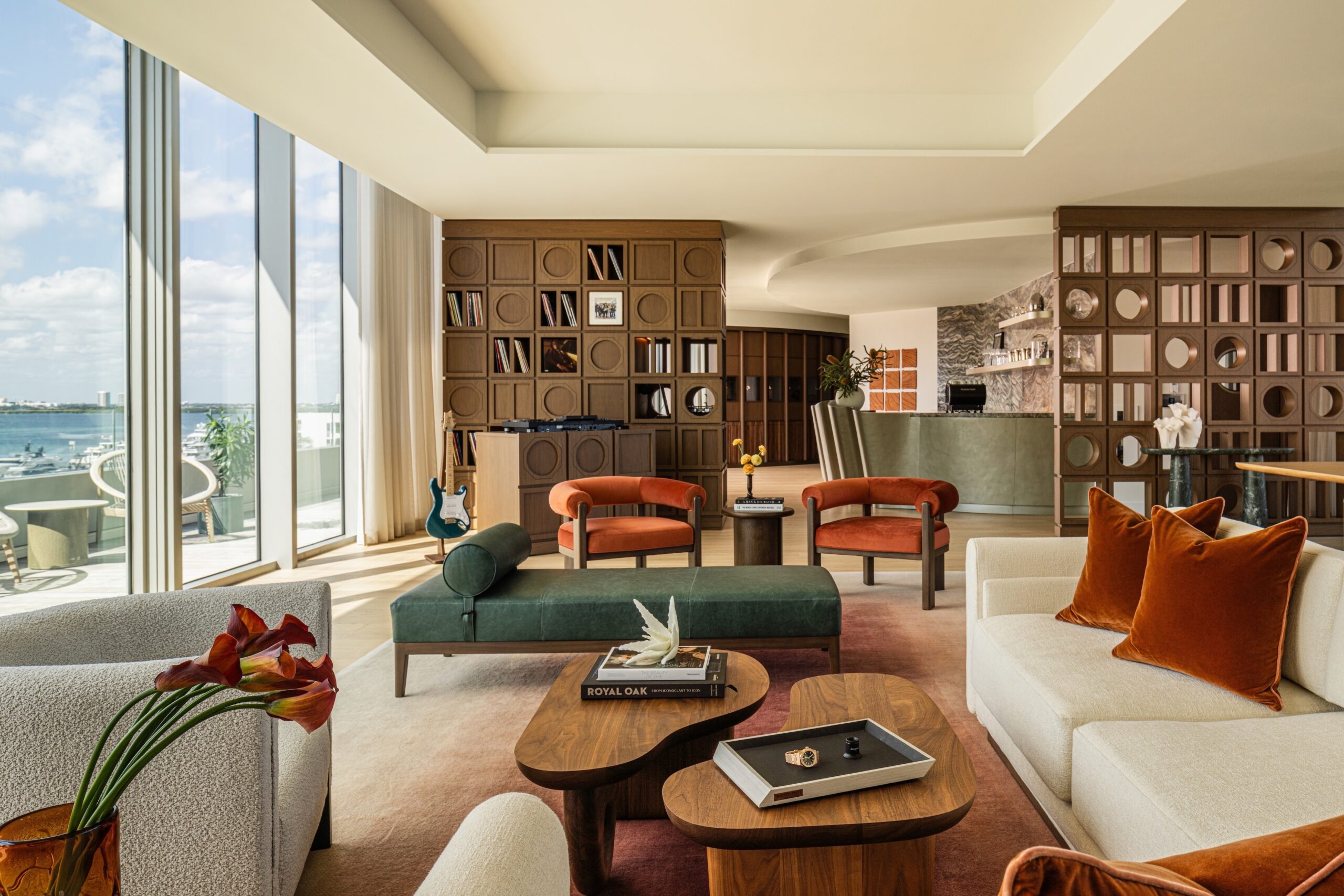
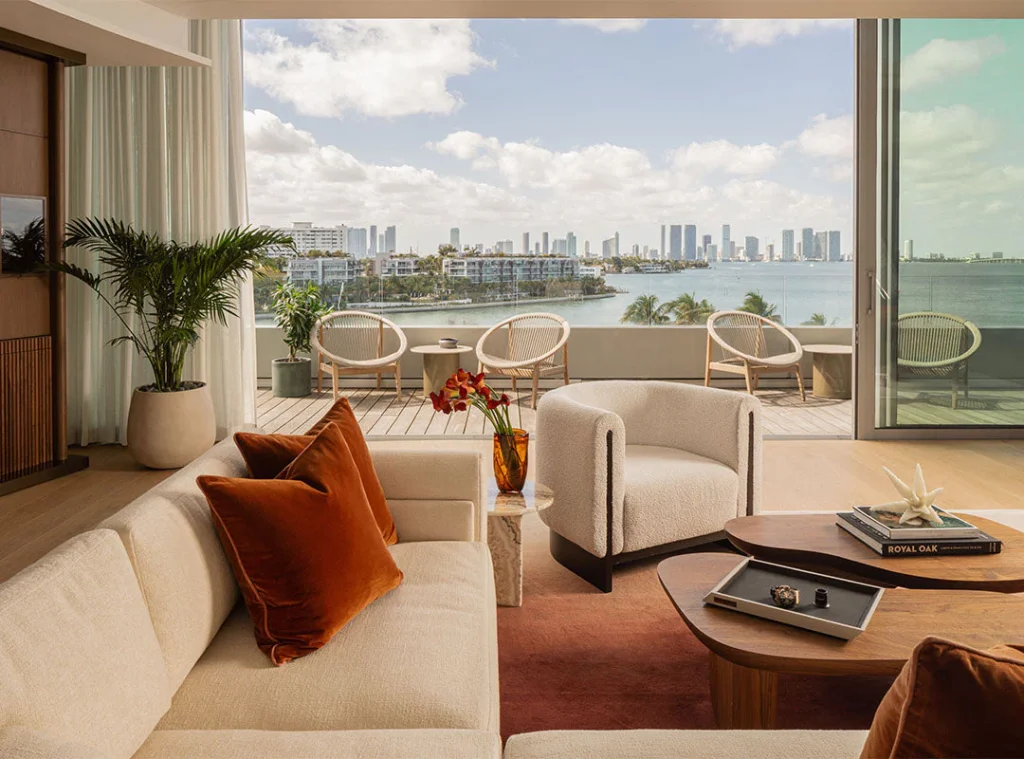
The opening of AP House Miami signals something larger than a new boutique. Luxury’s most storied brands are no longer selling products. They’re building worlds you want to live in.
That sounds like a strange thing to say about Audemars Piguet, a manufacture that has spent 151 years perfecting the art of measuring time. But standing inside AP House Miami, which opened this month at 1759 Purdy Ave in Sunset Harbour, the Royal Oaks on display feel less like merchandise and more like punctuation. The real story is the room itself.
Studio DADO, the Miami-based design team AP brought in for the project, did not design a store. They designed a residence. Blush tones that catch the afternoon light. Soft edges where you’d expect sharp ones. Stone, wood, and textured glass that belong in a well-considered home rather than a commercial space. A record player in the corner, with hand-selected albums and books for guests to browse. A terrazzo-floor terrace with views across the Miami skyline, designed purely for the pleasure of watching the sun go down. Sculptures by Brazilian ceramic artist Sallisa Rosa sit alongside rotating works from the Wilde Gallery in Geneva. Nothing here announces itself. It reveals itself.
Audemars Piguet’s own language for the concept is telling. The AP House, they say, was built by imagining how founders Jules Louis Audemars and Edward Auguste Piguet would receive clients today — traveling, hosting, sharing their passion the way a person invites you into their home rather than their showroom. When AP CEO of the Americas Louis-Gabriel Fichet describes the space as defined by “hospitality, creativity, and a vibrant cultural point of view,” he is not reaching for marketing language. He is describing an operating philosophy.
The concept launched in Hong Kong in 2018 with a 2,700-square-foot space designed to feel like a luxury apartment. Miami, at 7,300 square feet, is the full expression of what that early instinct has become.
This is not an accident. It’s a strategy. And it connects directly to the same shift Branded Living has been documenting in the branded residences sector for the past two years.
We have written about the dissolution of the line between hotel and home, the Four Seasons residence that functions like a hotel room you own, the Aman that has decided the ambiguity between stay and lifestyle is the product. What branded residences understood early is that the buyer does not want a transaction. They want to belong somewhere. Luxury retail has arrived at the same conclusion.
Credit: Audemars Piguet
The AP House format is not a boutique with nicer furniture. It is a framework for belonging. The micro-museum of celebrated timepieces gives the space memory and weight. The watchmaker’s hutch, where visitors sit with an expert or quietly consider a strap change, creates intimacy. The lounges are designed for lingering, not browsing. The entire space is organized around a single proposition: you are a guest here, not a customer.
The branded residences developer who reads this should recognize the architecture of that proposition immediately.
The Ritz-Carlton Residences buyer is not purchasing square footage in Tampa or Naples. They are joining something. The brand pre-qualifies the culture before the resident ever arrives. AP is doing the same thing. The person who walks into AP House Miami is being invited to see themselves as part of the AP universe, the collector who values relationships over transactions, the traveler who expects every room they enter to meet a certain standard. The space does the qualifying. The watch, when it arrives, almost sells itself.
The question is whether this convergence is a coincidence or a signal.
Other luxury houses are asking similar questions. The Hermès flagship in Paris has always felt more like entering a private apartment than a store. LVMH’s approach to the Cheval Blanc brand essentially erases the boundary between hotel, residence, and retail. These are not just beautiful spaces. They are tests of a hypothesis: that the highest-value luxury customer no longer distinguishes between where they shop, where they stay, and where they live. They want consistency of experience across all three.
If that hypothesis holds, and the evidence from branded residences suggests it does, then luxury retail is not borrowing aesthetics from residential design. It is entering the same category.
AP House Miami is, at one level, the brand’s second act in a city it entered in 2006 with its Bal Harbour Boutique. At another level, it is a declaration that the store was never the point. The relationship was always the point. The space is just where the relationship lives.
That is a distinction the branded residences sector understood before almost anyone else.